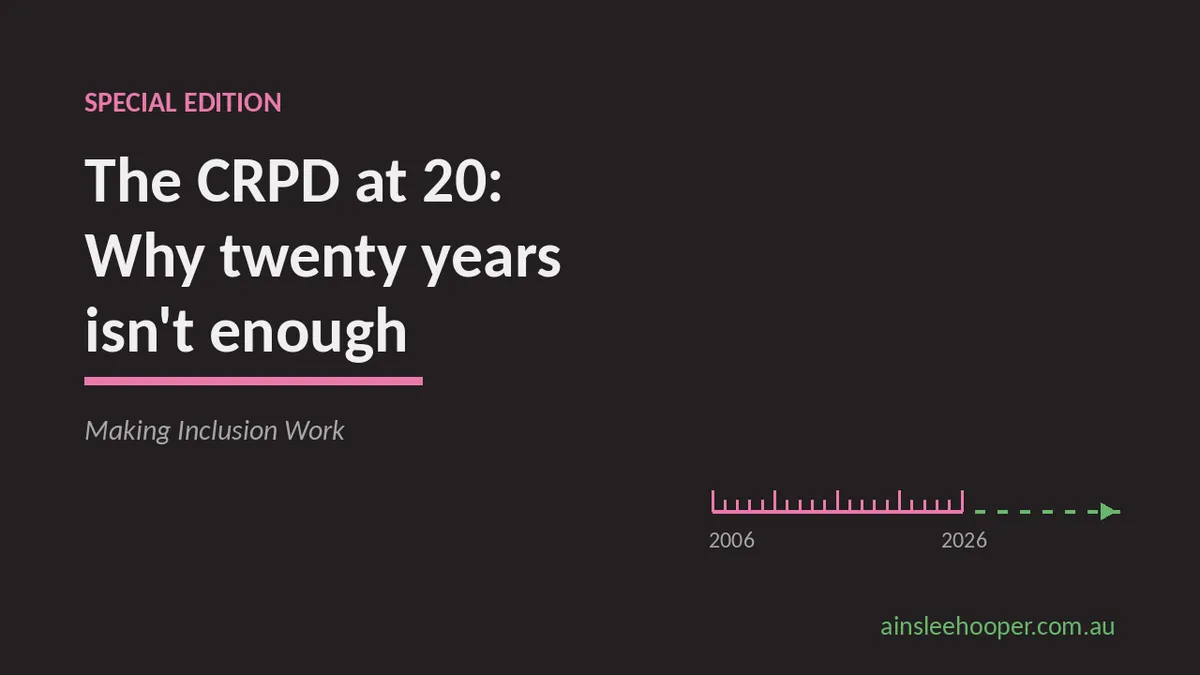
SPECIAL EDITION: The CRPD at 20: Why Twenty Years Isn't Enough
On 3 December, the International Day of People with Disability marks a milestone. The UN Convention on the Rights of Persons with Disabilities (CRPD) turns 20.
The UN theme is "The CRPD at 20: Building on Progress, Advancing the Future."
It has two halves. Building on progress looks back. Advancing the future is about what changes next. Most IDPwD activity lives comfortably in the first half. This edition is about why the second half matters, and there's recent proof.
The progress worth building on
On 13 December 2006, the UN General Assembly adopted the CRPD. It was the first human rights treaty negotiated with the people it was written for. Disabled people and their organisations took part throughout, and the process gave real meaning to the disability movement's motto: "Nothing about us without us." Australia ratified the Convention in 2008.
That shows in what the Convention says. It doesn't treat disabled people as a group to be managed or looked after. It treats us as people with rights, and treats the barriers around us as the thing that needs to change.
Two articles matter most here.
Article 19 says disabled people have the right to choose where and with whom they live, on an equal basis with others, and are not obliged to live in a particular living arrangement.
Article 4(3) requires governments to closely consult with and actively involve disabled people in the decisions that affect them.
Choice, and a say. Twenty years later, both still lose to a good sales pitch.
The proof: The Experiment
Last month, Channel 4 in the UK aired The Experiment. Members of the public toured SegriLife House, presented as a progressive supported-living home for disabled adults. Disabled and neurodivergent actors played the residents. What visitors weren't told until afterwards was that SegriLife wasn't real, and that its ideas were drawn from Nazi propaganda about disabled people.
Many visitors liked what they saw. One said: "It's safe. That's what the people we've just met need."
Nobody was shown cruelty. They were shown segregation, packaged as care, and it made sense to them. The pitch was about what disabled people "need". They had already made that decision for them, and it sounded kind.
That is exactly what Articles 19 and 4(3) were written against.
It's tempting to treat this as a British problem. It isn't. The commissioners of Australia's Disability Royal Commission couldn't agree on whether to phase out segregated schools and segregated employment. Here too, the question of who gets to decide what "support" looks like is still open.
The Convention's ideas are written down. They aren't yet the default.
Advancing the future
The visitors at SegriLife weren't bad people. That's what makes the programme so uncomfortable to watch. They were ordinary, well-meaning people responding to language they'd heard all their lives: safe, protected, specialised, what they need.
That language is still everywhere. It's in how services are described, how options are explained to families, and how decisions get justified. It isn't usually cruel. It's usually sincere. And it usually means a decision has been made about disabled people without them.
So the most useful thing anyone can do this IDPwD is learn to hear it. When something for disabled people is described as safer, more appropriate or what they need, ask two questions:
1. Who decided?
2. Were disabled people part of deciding, while it could still change?
What to do before 3 December
If you lead an organisation or approve its IDPwD plans: look at who is designing your day. If disabled people are only the audience, or the guest speaker, change that now. Bring them into the planning, and pay them for it.
If you sit on a board: ask management the two questions about one decision the organisation has made this year that affects disabled people. Ask for the answer to come back to the board.
If you do the work but don't hold the budget: listen for the language this month, in your meetings, your documents and your own writing. When you hear it, ask the two questions out loud. It's a small act, and it's exactly what the Convention asks for.
Over to you
Where have you heard "it's for their own good" used to make a decision about disabled people, without them? Drop a comment.
Work With Me
This edition's test: two questions, drawn from the CRPD.
1. Who decided?
2. Were disabled people part of deciding, while it could still change?
If your organisation struggles to answer them, I can help.
DIAP development and review · Governance and committee reviews · Co-design and stakeholder engagement · Disability Inclusion Outcomes Framework™ · The Inclusion Lens
Book a Complimentary Strategy Call: https://ainsleehooper.com.au/book-a-call
Workplace Disability Inclusion Assessment: https://ainsleehooper.com.au/free-resources/workplace-disability-inclusion-assessment/
Framework Strategy Call: https://ainsleehooper.com.au/book-a-call
Sources
- United Nations Department of Economic and Social Affairs, 2026 International Day of Persons with Disabilities (theme and date): https://social.desa.un.org/issues/disability/events/2026-international-day-of-persons-with-disabilities-idpd
- UN Audiovisual Library of International Law, Convention on the Rights of Persons with Disabilities, introductory note (adoption on 13 December 2006, stakeholder participation, "Nothing about us without us"): https://legal.un.org/avl/pdf/ha/crpd/crpd_e.pdf
- Humanity & Inclusion, The CRPD negotiations (role of disabled people's organisations): https://hi.org/crpd/en/development-and-special-atmosphere-of-the-negotiations
- Convention on the Rights of Persons with Disabilities, full text (Articles 4 and 19): https://www.ohchr.org/en/instruments-mechanisms/instruments/convention-rights-persons-disabilities
- Australian Law Reform Commission, Equality, Capacity and Disability in Commonwealth Laws (Australia's ratification in 2008): https://www.alrc.gov.au/publication/equality-capacity-and-disability-in-commonwealth-laws-alrc-report-124/2-conceptual-landscape-the-context-for-reform-2/international-context-3/
- Channel 4, The Experiment press release, 22 October 2026: https://www.channel4.com/press/news/experiment-would-you-recognise-cruelty-if-it-was-dressed-care-channel-4-explores-whether
- Big Issue, Mat Fraser on why they made The Experiment (visitors informed afterwards): https://www.bigissue.com/culture/tv/why-we-made-controversial-channel-4-documentary-the-experiment/
- Frances Ryan, review of The Experiment, The Guardian, 21 October 2026 (visitor quote): https://www.theguardian.com/tv-and-radio/2026/oct/21/the-experiment-channel-four-tv-review-uk-nazi-disability
- City Hub, Split decision in ending segregated education and employment for people with disability (Royal Commission): https://cityhub.com.au/split-decision-in-ending-segregated-education-and-employment-for-people-with-disability